
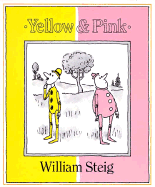

One of my favorite children’s books to use in philosophy classes (including with high school students) is William Steig’s Yellow and Pink.
The story begins with two small wooden figures, one pink and one yellow, who are lying on old newspaper. The yellow one sits up and asks the pink one, “Do you happen to know what we’re doing here?” The two engage in a conversation about whether someone created them (Pink’s view) or whether, as Yellow contends, “we’re an accident, somehow or other we just happened.” The story follows their speculations about how they might either have been created or just exist by chance.
When I’ve discussed this book in pre-college classes, we’ve explored the following questions:
What does it mean to create something?
Have the following things been created? If so, how?
Trees
Children
Stories
Pizza
Clouds
Ideas
Colors
Does everything have to have a beginning?
Does everything have to have a cause?
If we can’t imagine something, does that mean it’s not possible?
 Jana Mohr Lone is the director and founder of the University of Washington Center for Philosophy for Children, an academic research center dedicated to research and practice in philosophy for children and philosophy of childhood, and she is an Affiliate Associate Professor of Philosophy at the University of Washington. Jana is the author of Seen and Not Heard (2021) and The Philosophical Child (2012). She co-authored the textbook Philosophy in Education: Questioning and Dialogue in Schools (2016) and co-edited the collection of essays Philosophy and Education: Introducing Philosophy to Young People (2012). Since 1995 she has taught philosophy in classrooms from preschool to college and beyond. A frequent writer and speaker about precollege philosophy, Jana is the founding president of PLATO (Philosophy Learning and Teaching Organization) and the founding editor-in-chief of the journal Questions: Philosophy for Young People. Follow her on Twitter: @JanaMohrLone