
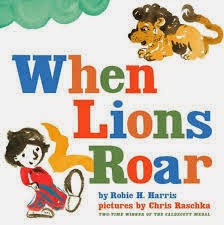

Can we control our feelings? Our perceptions? Does how we feel affect what happens in the world?
When Lions Roar, a simple picture book by Robie Harris, depicts how scary the world can feel when “lions roar,” “thunder booms,” “big dogs bark,” “mommies holler,” and so on. The child in the story responds, “I sit right down, shut my eyes tight. ‘Go away,’ I say. ‘Scary! Go away.'”
Then, the story goes on, it’s quiet again, with the wind still and the sun out. “The scary is gone.”
What makes some things scary? Are there different levels of scariness? If something is scary, does that mean we are scared of it? Can we control whether something scares us? Is it possible for our actions to get rid of something that we find scary?
Especially (but certainly not only) for young children, it can be empowering to talk about what makes something scary and the many different ways we can react to what feels scary to us. Is what is scary in the thing or in us?
 Jana Mohr Lone is the director and founder of the University of Washington Center for Philosophy for Children, an academic research center dedicated to research and practice in philosophy for children and philosophy of childhood, and she is an Affiliate Associate Professor of Philosophy at the University of Washington. Jana is the author of Seen and Not Heard (2021) and The Philosophical Child (2012). She co-authored the textbook Philosophy in Education: Questioning and Dialogue in Schools (2016) and co-edited the collection of essays Philosophy and Education: Introducing Philosophy to Young People (2012). Since 1995 she has taught philosophy in classrooms from preschool to college and beyond. A frequent writer and speaker about precollege philosophy, Jana is the founding president of PLATO (Philosophy Learning and Teaching Organization) and the founding editor-in-chief of the journal Questions: Philosophy for Young People. Follow her on Twitter: @JanaMohrLone