
.jpg)
“Can art be emotionless?” one student asked in one of the classes. All of the students who responded wanted to claim that art must express emotion.
“All art expresses some emotion,” one student argued, “even if it’s just boredom.”
“But how do we know what emotion art is expressing?” another student asked. “It could be that we see a painting and think it’s sad, but really the artist and the person in the painting were happy.”
Several students maintained that expression, color, a subject’s body language, etc. all suggest certain emotions. Some of us might see the painting as expressing an emotion that is different from the one the artist intended, which led some students to assert that really the emotion is in us, and not in the art.
“Art just triggers emotion,” one student declared, “but the emotion it triggers is in us and not in the art.”
This led us to a discussion about what makes something art. I wadded up a piece of paper and threw it onto a table. “What if I said this was a new work of art I’d just created?”
“Well,” one student responded, “that could be art if you were intending to express something.”
“Okay,” I answered, “so if I said this was my expression of how pointless life seemed, that would make this crumpled-up paper art?”
“Yes,” another student put in. “If you intended to express that, it could be art. But if I was doing my homework and crumpled up the paper I was working on because it was wrong and planned to throw it in the garbage, that wouldn’t be art.”
“So can anything be art?” I asked.
In both classes, most students seemed to think that yes, anything can be art, though some of it is “bad art.” What really matters, most suggested, is the intention of the artist.
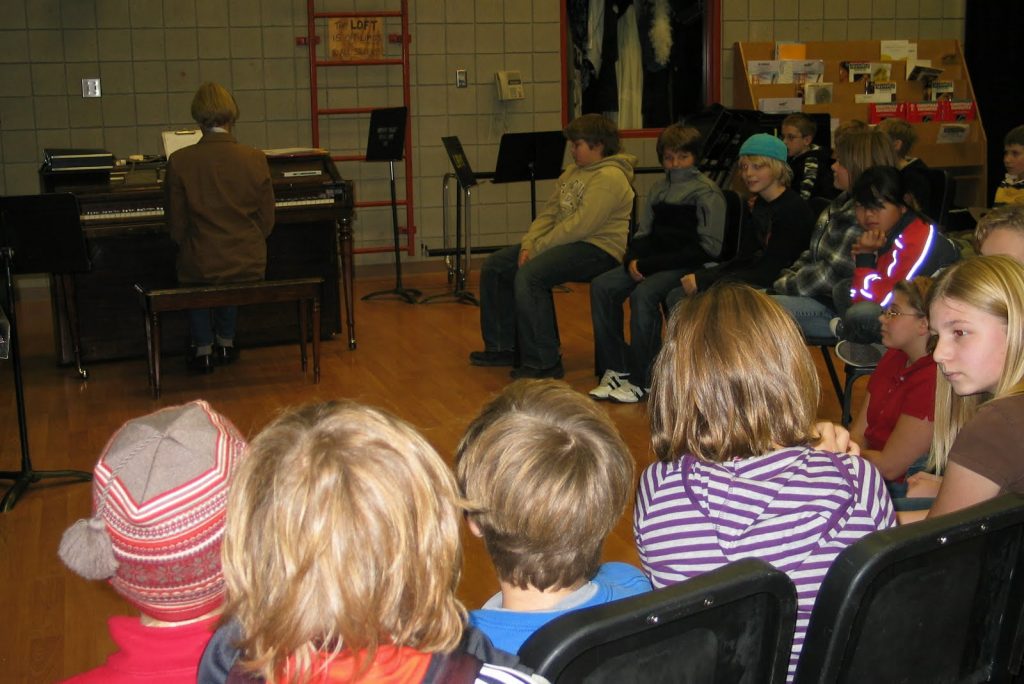
When we came into the band room for the performance of John Cage’s piece, the students were, of course, expecting to hear a performance of a traditional music piece. They were, just as students with whom I did this last year were, completely respectful and quiet during the performance of the piece. When it ended, they applauded, and when I asked them what they had experienced, the students observed that the effect of the piece was very relaxing and peaceful. One student commented that they had all been kind of “noisy and jittery” when we all came into the room, and noted how calm and quiet the room had become. Others commented on the way that the piece had allowed them to listen to all the sounds in the room in a way they wouldn’t have otherwise. We talked about Cage’s intention that the piece be a “listening experience.” Is 4’ 33” music?
Some of the ideas that came out of this conversation included the claim that for something to be music, there must be a listener, that even one note can be music, and that silence can be a kind of music. We referred back to our earlier conversation about the centrality of the artist’s intention. Cage’s intention in creating 4’ 33”, to generate in listeners a greater openness to listening to all the sounds in the world, was decisive for most students in their conclusion that the piece counts as music. I wonder if this discussion leads the students to notice more the sounds in their lives, and to explore whether all or some of these sounds are music and what makes them so.
 Jana Mohr Lone is the director and founder of the University of Washington Center for Philosophy for Children, an academic research center dedicated to research and practice in philosophy for children and philosophy of childhood, and she is an Affiliate Associate Professor of Philosophy at the University of Washington. Jana is the author of Seen and Not Heard (2021) and The Philosophical Child (2012). She co-authored the textbook Philosophy in Education: Questioning and Dialogue in Schools (2016) and co-edited the collection of essays Philosophy and Education: Introducing Philosophy to Young People (2012). Since 1995 she has taught philosophy in classrooms from preschool to college and beyond. A frequent writer and speaker about precollege philosophy, Jana is the founding president of PLATO (Philosophy Learning and Teaching Organization) and the founding editor-in-chief of the journal Questions: Philosophy for Young People. Follow her on Twitter: @JanaMohrLone