
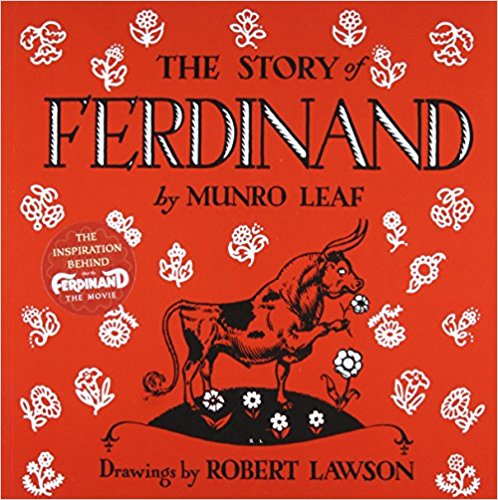
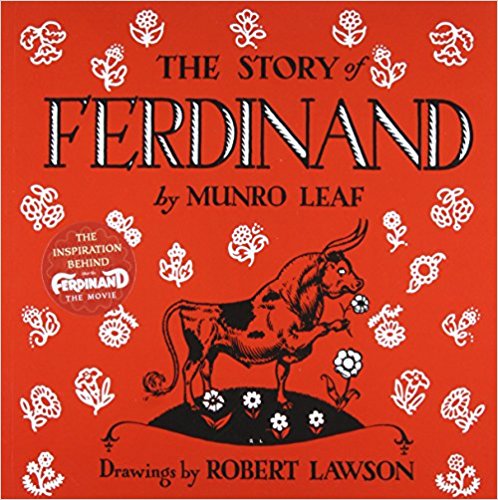
The Story of Ferdinand by Munro Leaf (illustrator Robert Lawson) is the story of a young bull, Ferdinand, growing up in Spain. Ferdinand, unlike all the other little bulls around him, does not spend his time running and jumping and butting heads with other bulls. Ferdinand likes “to sit just quietly and smell the flowers.”
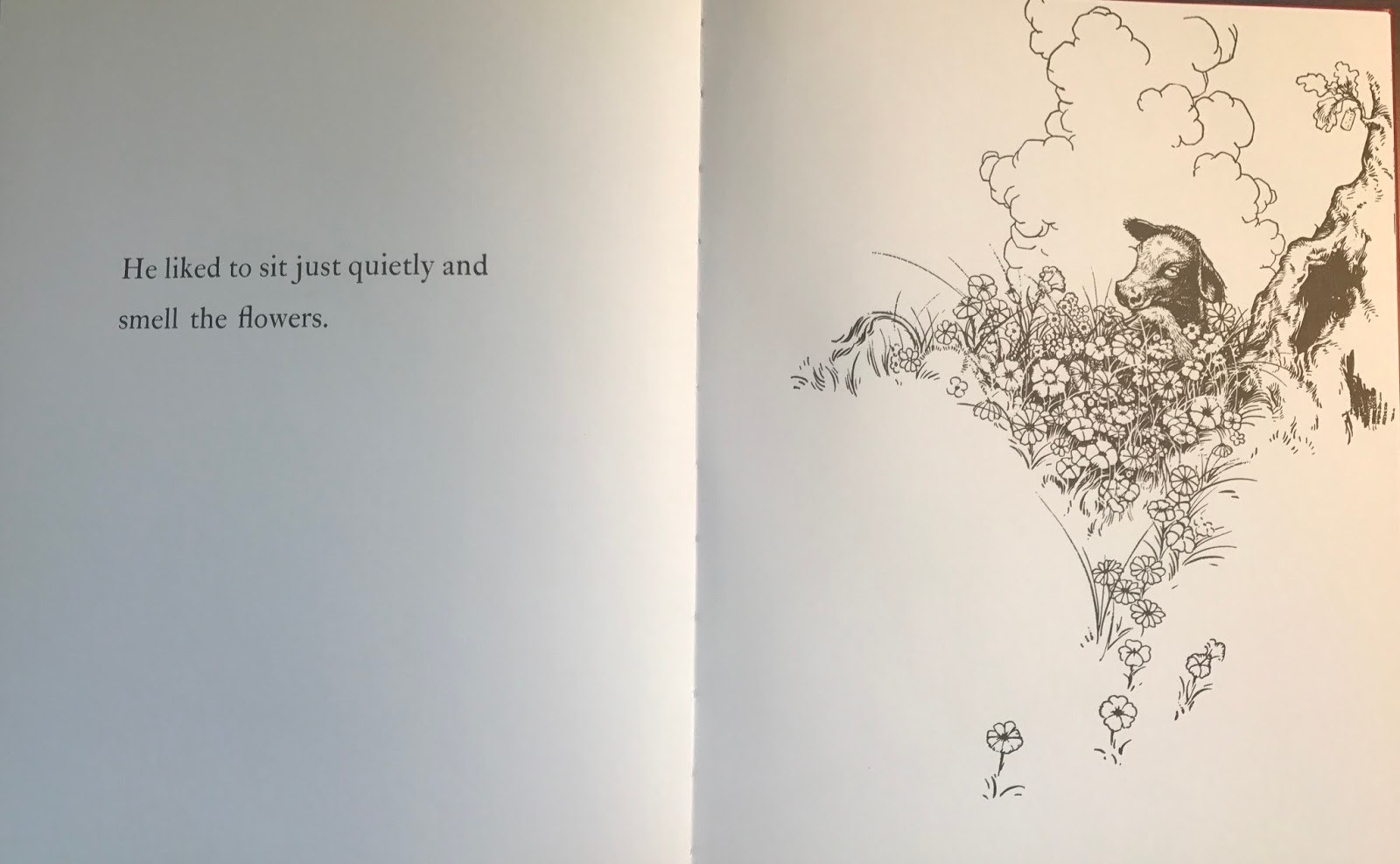
Ferdinand sits under his favorite tree all day by himself and smells the flowers. Sometimes his mother worries that he will be “lonesome by himself.” But she sees that he is happy just sitting alone, so she lets him be.
Ferdinand grows up very big and strong, but he is not interested in being picked to fight at the bull fights in Madrid. However, one day five men come to pick the “biggest, fastest, roughest bull” to go to Madrid. Ferdinand, indifferent to all this, heads out to sit under his favorite tree, and accidentally sits on a bumble bee, who stings him. In pain, Ferdinand runs around “puffing and snorting, butting and pawing the ground as if he were crazy.” The five men from Madrid see him and are thrilled to choose him for the bull fights.
On bull fight day the men take Ferdinand away in a cart to the ring in Madrid. Flags are flying, bands are playing, and “all the lovely ladies” have “flowers in their hair.” When Ferdinand is led into the ring, announced as “Ferdinand the Fierce,” he sees the flowers in the ladies’ hair and he “just sat down quietly and smelled.” No matter what anyone does, Ferdinand won’t “fight and be fierce,” but just sits there serenely. So he is taken home, where he can go back to sitting by himself under his cork tree. The story ends by telling us, “He is very happy.”
The story raises questions about identity, community, respect and trust, and the nature of happiness, including:
- Ferdinand seems to be different from all the other bulls, but that doesn’t seem to bother him. Why do you think Ferdinand is so comfortable being different from others?
- Is it acceptable not to participate in your community at all?
- Why does Ferdinand’s mother stop worrying about him and let him spend all his time alone?
- Is Ferdinand lonely? Is there a difference between being lonely and being alone?
- The story ends by telling us that Ferdinand is happy. What does it mean to be happy?
- Can you be happy spending all of your time by yourself? Can you be happy if you never spend time by yourself?
 Jana Mohr Lone is the director and founder of the University of Washington Center for Philosophy for Children, an academic research center dedicated to research and practice in philosophy for children and philosophy of childhood, and she is an Affiliate Associate Professor of Philosophy at the University of Washington. Jana is the author of Seen and Not Heard (2021) and The Philosophical Child (2012). She co-authored the textbook Philosophy in Education: Questioning and Dialogue in Schools (2016) and co-edited the collection of essays Philosophy and Education: Introducing Philosophy to Young People (2012). Since 1995 she has taught philosophy in classrooms from preschool to college and beyond. A frequent writer and speaker about precollege philosophy, Jana is the founding president of PLATO (Philosophy Learning and Teaching Organization) and the founding editor-in-chief of the journal Questions: Philosophy for Young People. Follow her on Twitter: @JanaMohrLone