
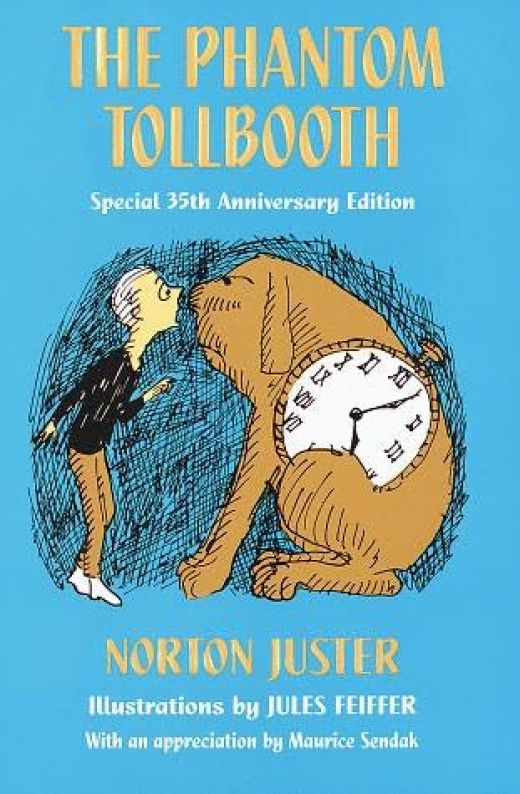

I recently reread The Phantom Tollbooth by Norton Juster, one of my favorite books in elementary school. Published in 1961, with marvelous line drawings by Jules Feiffer, the book tells the story of Milo, a bored young boy who sees thinks that everything is a waste of time. He is given a gift of a magic tollbooth that allows him to explore new places and teaches him that the world is fascinating and beautiful.
Full of puns, logic puzzles and philosophical jokes, the novel is a great one to read and discuss with your child or with a class of children. It raises questions about perception (can you see sounds?), the nature of reality (what is infinity?), the meaning of life, knowledge and the mind, the power of words and numbers, nothingness, and the ways in which our perspectives construct the reality we think we know. Funny and exciting, the book is great fun and a philosophical treasure chest for young people.
 Jana Mohr Lone is the director and founder of the University of Washington Center for Philosophy for Children, an academic research center dedicated to research and practice in philosophy for children and philosophy of childhood, and she is an Affiliate Associate Professor of Philosophy at the University of Washington. Jana is the author of Seen and Not Heard (2021) and The Philosophical Child (2012). She co-authored the textbook Philosophy in Education: Questioning and Dialogue in Schools (2016) and co-edited the collection of essays Philosophy and Education: Introducing Philosophy to Young People (2012). Since 1995 she has taught philosophy in classrooms from preschool to college and beyond. A frequent writer and speaker about precollege philosophy, Jana is the founding president of PLATO (Philosophy Learning and Teaching Organization) and the founding editor-in-chief of the journal Questions: Philosophy for Young People. Follow her on Twitter: @JanaMohrLone