
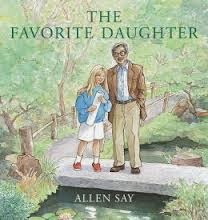
Allen Say’s picture book The Favorite Daughter is dedicated to his daughter. It’s the story of Yuriko, who is half Japanese. She is upset when other children make fun of her name and tease her about a photo of her wearing a kimono because she has blond hair. Her art teacher mispronounces her name, calling her “Eureka.” Yuriko decides she wants to change her name to Michelle, but after she and her father visit a Japanese restaurant and the Japanese Garden at Golden Gate Park, Yuriko begins to appreciate her uniqueness.
The lovely watercolor and pen and ink illustrations and the emotional expressiveness of Say writing about his daughter enhance the appeal of this book to children, and the story raises a range of interesting philosophical questions. What is the significance of a name? How do our names identify and define us? What makes up our cultural identity? Can it change? What does it mean to be part of a community? Can we be unique individuals and belong to a group at the same time?
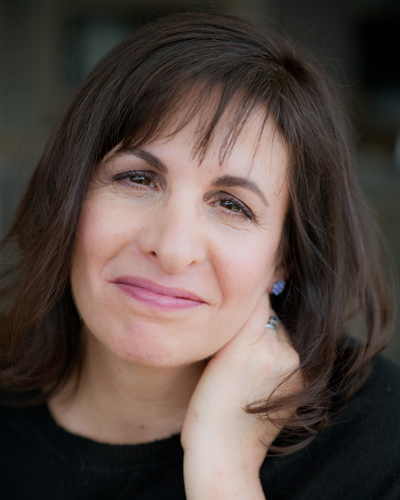 Jana Mohr Lone is the director and founder of the University of Washington Center for Philosophy for Children, an academic research center dedicated to research and practice in philosophy for children and philosophy of childhood, and she is an Affiliate Associate Professor of Philosophy at the University of Washington. Jana is the author of Seen and Not Heard (2021) and The Philosophical Child (2012). She co-authored the textbook Philosophy in Education: Questioning and Dialogue in Schools (2016) and co-edited the collection of essays Philosophy and Education: Introducing Philosophy to Young People (2012). Since 1995 she has taught philosophy in classrooms from preschool to college and beyond. A frequent writer and speaker about precollege philosophy, Jana is the founding president of PLATO (Philosophy Learning and Teaching Organization) and the founding editor-in-chief of the journal Questions: Philosophy for Young People. Follow her on Twitter: @JanaMohrLone