
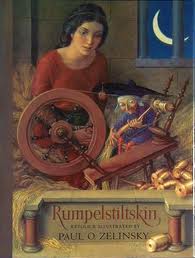

I’ve been re-reading fairy tales and exploring their philosophical potential. So many questions, especially about ethics, are raised by these stories! I just read a version of the Brothers Grimm story Rumpelstiltskin, as retold and illustrated by Paul Zelinsky. The story can be read, of course, as a morality tale about the greed of Rumpelstiltskin and his willingness to take advantage of the desperation of the miller’s daughter, who must spin straw into gold or the king will have her killed.
But the story is more complex than that. It raises many ethical, as well as social and political issues. For example, the absolute power of the king. Is his demand that the miller’s daughter spin straw into gold, or die, any worse than Rumpelstiltskin’s insistence that she keep her promise to give him her first-born child? And once the miller’s daughter (who is never given a name) manages (with the help of Rumpelstiltskin) this feat, the king marries her – again, the miller’s daughter clearly has no choice about this either. Who is the real villain in the story – Rumpelstiltskin or the king?
Rumpelstiltskin asks the miller’s daughter to promise him her necklace, her ring, and then (when she has no material things left) her first child – are the first two requests morally permissible? Should Rumpelstiltskin help her without asking for anything in return? Is it just the final request that is over the moral line? Should the miller’s daughter have made this promise? Why isn’t she obligated to keep it?
 Jana Mohr Lone is the director and founder of the University of Washington Center for Philosophy for Children, an academic research center dedicated to research and practice in philosophy for children and philosophy of childhood, and she is an Affiliate Associate Professor of Philosophy at the University of Washington. Jana is the author of Seen and Not Heard (2021) and The Philosophical Child (2012). She co-authored the textbook Philosophy in Education: Questioning and Dialogue in Schools (2016) and co-edited the collection of essays Philosophy and Education: Introducing Philosophy to Young People (2012). Since 1995 she has taught philosophy in classrooms from preschool to college and beyond. A frequent writer and speaker about precollege philosophy, Jana is the founding president of PLATO (Philosophy Learning and Teaching Organization) and the founding editor-in-chief of the journal Questions: Philosophy for Young People. Follow her on Twitter: @JanaMohrLone