
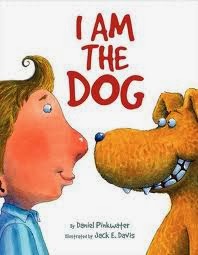

Daniel Manus Pinkwater’s I Am the Dog tells the story of Jacob, a boy, and his dog Max. One day they decide to change places. Jacob eats from a bowl on the floor while Max eats at the table with the family. Jacob runs around the yard while Max goes to school. Max does homework while Jacob snoozes on the floor. The next day, Jacob returns to being a boy and Max to being a dog. “That’s how things are supposed to be.” But, Jacob notes, they both learned that “being a dog is better.”
What makes a boy a boy? A dog a dog? Can a person change places with a dog? Is it better to be a dog than a human being? Do dogs eat off the floor and run around the yard because that is their nature? Can this be changed? Does it seem strange for a human to eat off the floor and run around the yard, and, if so, why?
 Jana Mohr Lone is the director and founder of the University of Washington Center for Philosophy for Children, an academic research center dedicated to research and practice in philosophy for children and philosophy of childhood, and she is an Affiliate Associate Professor of Philosophy at the University of Washington. Jana is the author of Seen and Not Heard (2021) and The Philosophical Child (2012). She co-authored the textbook Philosophy in Education: Questioning and Dialogue in Schools (2016) and co-edited the collection of essays Philosophy and Education: Introducing Philosophy to Young People (2012). Since 1995 she has taught philosophy in classrooms from preschool to college and beyond. A frequent writer and speaker about precollege philosophy, Jana is the founding president of PLATO (Philosophy Learning and Teaching Organization) and the founding editor-in-chief of the journal Questions: Philosophy for Young People. Follow her on Twitter: @JanaMohrLone