
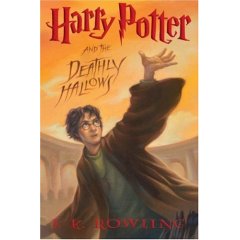

I’ve been thinking how much fun it would be to teach a year-long course that involved reading and talking about all of the novels, perhaps to fifth or sixth grade students. The stories are so full of philosophical suggestiveness. It would be interesting to teach them together with an English teacher, and read the novel from both literary and philosophical perspectives.
As I read the final novel, Harry Potter and the Deathly Hallows, I created a list of some of the philosophical questions that occurred to me as I read:
The “Mirror of Erised” is a mystical mirror that shows the “deepest and most desperate desires of our hearts.” What do you think you would see looking into the mirror? Would the mirror be able to tell you something you don’t know? If you are not sure of the “deepest desire of your heart,” can it be really be your deepest desire?
What does it mean to trust other people? What must be true for us to say we “trust someone?” Can we ever trust someone completely? What would that mean?
Is bravery the absence of fear? Is it action despite fear? Is courage an act or a quality of a person? What does it entail?
What are the obligations of friendship? Do they vary based on circumstances? If so, what circumstances?
“Horcruxes” are objects used to split a person’s soul and thus seek immortality. There is a comment in the novel that for Voldemort, splitting his soul is the same as splitting his mind. What does this mean? Are the soul and the mind the same thing, or only for Voldemort (and if so, how would that work)? What are the soul and the mind?
How do you prove something is not real?
If something is happening to you, is it real?
 Jana Mohr Lone is the director and founder of the University of Washington Center for Philosophy for Children, an academic research center dedicated to research and practice in philosophy for children and philosophy of childhood, and she is an Affiliate Associate Professor of Philosophy at the University of Washington. Jana is the author of Seen and Not Heard (2021) and The Philosophical Child (2012). She co-authored the textbook Philosophy in Education: Questioning and Dialogue in Schools (2016) and co-edited the collection of essays Philosophy and Education: Introducing Philosophy to Young People (2012). Since 1995 she has taught philosophy in classrooms from preschool to college and beyond. A frequent writer and speaker about precollege philosophy, Jana is the founding president of PLATO (Philosophy Learning and Teaching Organization) and the founding editor-in-chief of the journal Questions: Philosophy for Young People. Follow her on Twitter: @JanaMohrLone