
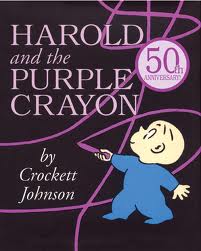

What can we know about the nature of reality? A wonderful story for motivating conversations about this question is Harold and the Purple Crayon by Crockett Johnson. First published in 1955, the story begins with Harold deciding, “after thinking it over for some time,” to take a walk in the moonlight. No moon is out, so Harold takes his purple crayon and draws one, and then he draws something to walk on. Harold goes on to draw a forest in which he wanders, a dragon that ends up frightening him, an ocean in which he almost drowns and a boat which saves him, a beach, a lunch to eat, etc.
This story was a favorite of my children when they were younger, and I have read it with children in classrooms from first grade through middle school. It raises such questions as: Is Harold pretending? Is what he draws real? How can what he draws scare him? Is the moon we see more real than Harold’s moon – and, if so, why? Is Harold dreaming? Can we create our own reality?
 Jana Mohr Lone is the director and founder of the University of Washington Center for Philosophy for Children, an academic research center dedicated to research and practice in philosophy for children and philosophy of childhood, and she is an Affiliate Associate Professor of Philosophy at the University of Washington. Jana is the author of Seen and Not Heard (2021) and The Philosophical Child (2012). She co-authored the textbook Philosophy in Education: Questioning and Dialogue in Schools (2016) and co-edited the collection of essays Philosophy and Education: Introducing Philosophy to Young People (2012). Since 1995 she has taught philosophy in classrooms from preschool to college and beyond. A frequent writer and speaker about precollege philosophy, Jana is the founding president of PLATO (Philosophy Learning and Teaching Organization) and the founding editor-in-chief of the journal Questions: Philosophy for Young People. Follow her on Twitter: @JanaMohrLone