
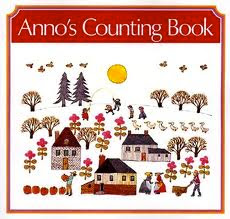

Anno’s Counting Book by Mitsumasa Anno is one of those books that my kids and I looked at constantly when they were in elementary school. Starting with 0 and ending with 12, it’s the most complex and interesting counting book I’ve ever encountered.
The first page is an empty landscape, corresponding to 0. The wordless book adds objects to each consecutive page, corresponding to each number and reflecting the seasons, time of day, and other events in nature and human life. The number of objects in the landscape grows exponentially and symmetrically, and the detailed watercolor illustrations inspire careful examination.
Anno’s Counting Book is a helpful book for developing mathematical understanding of basic and, later, more complex concepts, but what makes it extraordinary is its evocation of the beauty of numbers. It inspires questions about beauty and what makes something beautiful, about whether beauty can tell us anything about truth, and about the relationship between mathematics and aesthetics.
 Jana Mohr Lone is the director and founder of the University of Washington Center for Philosophy for Children, an academic research center dedicated to research and practice in philosophy for children and philosophy of childhood, and she is an Affiliate Associate Professor of Philosophy at the University of Washington. Jana is the author of Seen and Not Heard (2021) and The Philosophical Child (2012). She co-authored the textbook Philosophy in Education: Questioning and Dialogue in Schools (2016) and co-edited the collection of essays Philosophy and Education: Introducing Philosophy to Young People (2012). Since 1995 she has taught philosophy in classrooms from preschool to college and beyond. A frequent writer and speaker about precollege philosophy, Jana is the founding president of PLATO (Philosophy Learning and Teaching Organization) and the founding editor-in-chief of the journal Questions: Philosophy for Young People. Follow her on Twitter: @JanaMohrLone