
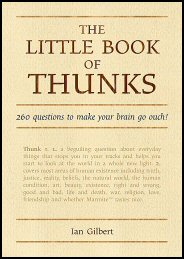

Thunk: “a beguiling simple-looking question about everyday things that stops you in your tracks and helps you start to look at the world in a whole new light.”
The Little Book of Thunks is a wonderful resource for talking about philosophy in a classroom or with your own children. About the first quarter of the book discusses philosophy sessions with young people — how you can do them and why you should. The little book (and it is little, only 90-odd pages) then lists 260 thunks. For example:
The Little Book of Thunks is a wonderful resource for talking about philosophy in a classroom or with your own children. About the first quarter of the book discusses philosophy sessions with young people — how you can do them and why you should. The little book (and it is little, only 90-odd pages) then lists 260 thunks. For example:
Can you have a friend you don’t like?
Which is more important, being right or being nice?
Does a sound exist?
If you could take a pill that meant you would never fail, would you?
Can you touch the wind?
If I acquire your memory who am I then?
When you comb your hair, is it art?
Can a fly see a skyscraper?
Can you have a third of love?
Why don’t dogs laugh? Is it because they don’t have a sense of humor?
 Jana Mohr Lone is the director and founder of the University of Washington Center for Philosophy for Children, an academic research center dedicated to research and practice in philosophy for children and philosophy of childhood, and she is an Affiliate Associate Professor of Philosophy at the University of Washington. Jana is the author of Seen and Not Heard (2021) and The Philosophical Child (2012). She co-authored the textbook Philosophy in Education: Questioning and Dialogue in Schools (2016) and co-edited the collection of essays Philosophy and Education: Introducing Philosophy to Young People (2012). Since 1995 she has taught philosophy in classrooms from preschool to college and beyond. A frequent writer and speaker about precollege philosophy, Jana is the founding president of PLATO (Philosophy Learning and Teaching Organization) and the founding editor-in-chief of the journal Questions: Philosophy for Young People. Follow her on Twitter: @JanaMohrLone