
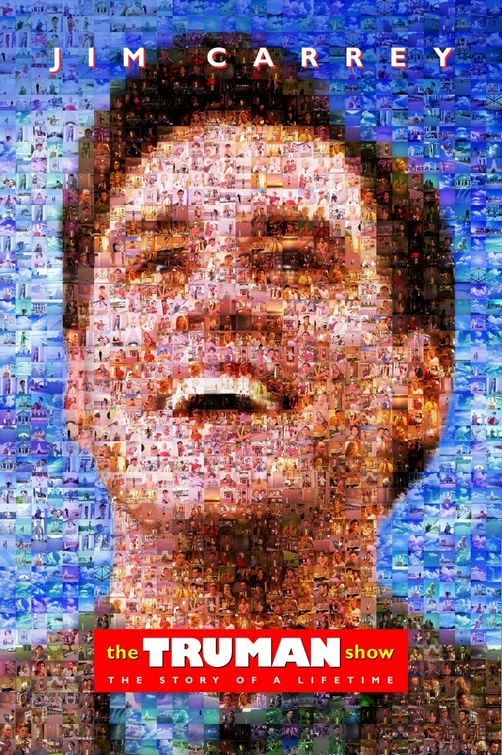

The Truman Show, by director Peter Weir, is a film about Truman Burbank, who is adopted at birth by a television network to be the star of a reality television show. Truman grows up unaware that his whole life is a staged television show, available 24 hours a day to viewers, and that everyone in his life is an actor, including his wife.
The film raises many philosophical questions, including questions about ethics, free will and determinism, the nature of truth, and the relationship between appearance and reality. It’s a provocative film for discussing these issues with middle and high school students. Some questions it raises are:
Is Truman’s life real?
Is “The Truman Show” morally acceptable?
Do we “accept the reality of the world with which we’ve been presented,” as the creator of “The Truman Show” asserts?
Does anyone know Truman?
Is creating a “perfect world” and imposing it on someone morally permissible? What would be the benefits of living in the safe, constructed world of “The Truman Show?”
Is there more truth in the world than in “The Truman Show?”
 Jana Mohr Lone is the director and founder of the University of Washington Center for Philosophy for Children, an academic research center dedicated to research and practice in philosophy for children and philosophy of childhood, and she is an Affiliate Associate Professor of Philosophy at the University of Washington. Jana is the author of Seen and Not Heard (2021) and The Philosophical Child (2012). She co-authored the textbook Philosophy in Education: Questioning and Dialogue in Schools (2016) and co-edited the collection of essays Philosophy and Education: Introducing Philosophy to Young People (2012). Since 1995 she has taught philosophy in classrooms from preschool to college and beyond. A frequent writer and speaker about precollege philosophy, Jana is the founding president of PLATO (Philosophy Learning and Teaching Organization) and the founding editor-in-chief of the journal Questions: Philosophy for Young People. Follow her on Twitter: @JanaMohrLone