
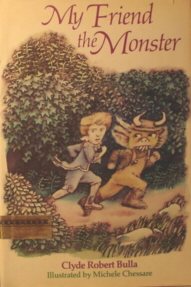

The short novel My Friend the Monster by Clyde Roberta Bulla is about the young Prince Hal, whose parents, the king and queen, think he is “ordinary” and have no time for him. They will not let him spend time with the children he sees playing in the courtyard because these children are the children of servants and, his parents tell him, are “far beneath” him.
Hal becomes friends with one of these children nevertheless, and learns through her about the “monsters” who live in their land. Eventually Hal ends up getting to know one of these monsters, who thinks of Hal as a “Small-Eyes,” an enemy who will try to kill him. The two end up becoming friends, despite the efforts of those around them to keep them from doing so.
The story explores in a moving and gripping way questions about what it means to be ordinary, the nature of freedom, what it means to be a good person, friendship, and the value of truth. I have read this story with elementary school students of a wide range of ages, and it never fails to captivate them.
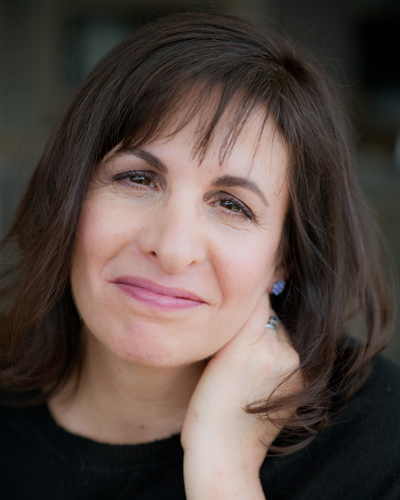 Jana Mohr Lone is the director and founder of the University of Washington Center for Philosophy for Children, an academic research center dedicated to research and practice in philosophy for children and philosophy of childhood, and she is an Affiliate Associate Professor of Philosophy at the University of Washington. Jana is the author of Seen and Not Heard (2021) and The Philosophical Child (2012). She co-authored the textbook Philosophy in Education: Questioning and Dialogue in Schools (2016) and co-edited the collection of essays Philosophy and Education: Introducing Philosophy to Young People (2012). Since 1995 she has taught philosophy in classrooms from preschool to college and beyond. A frequent writer and speaker about precollege philosophy, Jana is the founding president of PLATO (Philosophy Learning and Teaching Organization) and the founding editor-in-chief of the journal Questions: Philosophy for Young People. Follow her on Twitter: @JanaMohrLone