
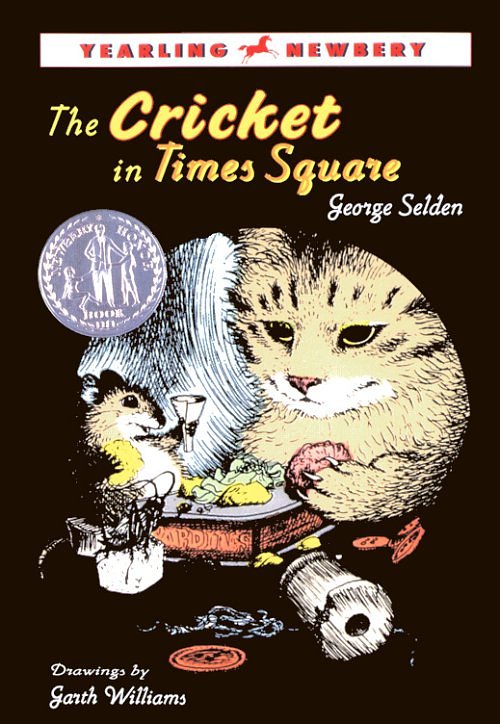

One of my favorite works of children’s literature, The Cricket in Times Square
The story involves Chester, a cricket, who arrives in Times Square in an accidental way from his country home in Connecticut and is befriended by Mario Bellini, whose family owns a newsstand in the Times Square subway station. Chester’s relationship with the Bellini family, his musical talent, his friendships with city-savvy Tucker Mouse and Harry the Cat, and his desire to help others are woven into a story that asks questions about happiness, our obligations to the people in our lives, talent and its cultivation, justice, and fairness.
For example, Chester’s musical ability becomes a sensation and brings people to the newsstand, which helps the struggling Bellini family and provides pleasure to all of the people who hear Chester’s music around the city. Chester, however, is uncomfortable with his growing fame and misses the rural life he knew in Connecticut. He wants to return there. Tucker Mouse, Harry the Cat and Chester have a conversation about whether this would be the right decision for Chester to make, weighing Chester’s happiness and his right to choose the course of his life against the possible negative consequences of this choice (the potentially negative effect on the Bellini newsstand, Mario’s sadness when Chester leaves, the loss of the opportunity to listen to Chester’s music for thousands of listeners, etc.).
Throughout the story, there are several junctures at which Chester and other characters must make moral decisions — whether to help someone else, tell the truth, abandon a difficult situation — and the characters’ discussions and reflections can motivate interesting discussions with children about these situations. Charmingly illustrated by Garth Williams, the story, in my experience, is completely engaging for children ages 5 to 12, and captivates older readers and listeners as well.
 Jana Mohr Lone is the director and founder of the University of Washington Center for Philosophy for Children, an academic research center dedicated to research and practice in philosophy for children and philosophy of childhood, and she is an Affiliate Associate Professor of Philosophy at the University of Washington. Jana is the author of Seen and Not Heard (2021) and The Philosophical Child (2012). She co-authored the textbook Philosophy in Education: Questioning and Dialogue in Schools (2016) and co-edited the collection of essays Philosophy and Education: Introducing Philosophy to Young People (2012). Since 1995 she has taught philosophy in classrooms from preschool to college and beyond. A frequent writer and speaker about precollege philosophy, Jana is the founding president of PLATO (Philosophy Learning and Teaching Organization) and the founding editor-in-chief of the journal Questions: Philosophy for Young People. Follow her on Twitter: @JanaMohrLone