
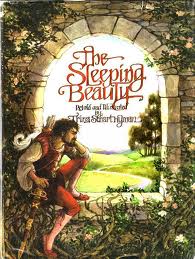

We all know the story of The Sleeping Beauty, on whom a curse is placed at birth. In the story, the 13th of thirteen wise women, angry because she is not invited to the celebration of Sleeping Beauty’s birth, announces a curse upon Sleeping Beauty: she will prick her finger on a spinning wheel on her 15th birthday, and fall down dead. The curse is mitigated by one of the other wise women, who states that, instead of dying, the princess will fall into a deep sleep for 100 years.
The King commands that all spinning wheels in the kingdom be destroyed. After some years, the King and Queen forget about the curse so that on her 15th birthday, Sleeping Beauty is left alone at the place. Exploring the palace, the princess finds a room in which there is an old woman spinning at a spinning wheel. Sleeping Beauty tries it and pricks her finger, falling into the foretold hundred-years sleep.
Sleeping Beauty‘s philosophical themes include destiny, promises, loss, betrayal, sleep, beauty, awakening, and the nature of time. Why doesn’t the King invite the 13th wise woman – does he have a good reason? Why do they royal couple leave their daughter alone when they are aware of the danger to her? Is this a betrayal? Was Sleeping Beauty aware of the curse upon her? Can we escape our destiny? When Sleeping Beauty wakes up after 100 years, is it possible that her kingdom still exists? Can time stop? Where is Sleeping Beauty during the long period of her sleep? Is she the same person when she wakes up that she was when she went to sleep? What does it mean to be “awakened?”
 Jana Mohr Lone is the director and founder of the University of Washington Center for Philosophy for Children, an academic research center dedicated to research and practice in philosophy for children and philosophy of childhood, and she is an Affiliate Associate Professor of Philosophy at the University of Washington. Jana is the author of Seen and Not Heard (2021) and The Philosophical Child (2012). She co-authored the textbook Philosophy in Education: Questioning and Dialogue in Schools (2016) and co-edited the collection of essays Philosophy and Education: Introducing Philosophy to Young People (2012). Since 1995 she has taught philosophy in classrooms from preschool to college and beyond. A frequent writer and speaker about precollege philosophy, Jana is the founding president of PLATO (Philosophy Learning and Teaching Organization) and the founding editor-in-chief of the journal Questions: Philosophy for Young People. Follow her on Twitter: @JanaMohrLone