
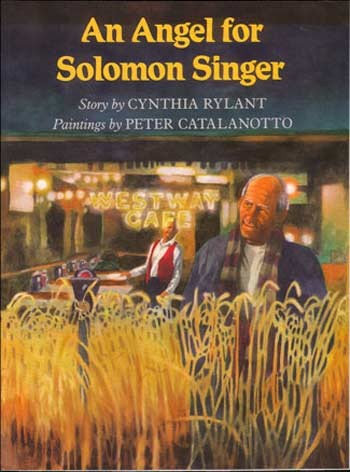

Cynthia Rylant’s story An Angel for Solomon Singer is the story of Solomon Singer, who lives in a hotel for men in New York City, and doesn’t like it. His room has no balcony or fireplace, and he cannot have a cat or dog, or even paint his walls a color of his choosing.
“It is important to love where you live, and Solomon Singer loved where he lived not at all, and it was this that drove him out into the street each night.” He wanders the streets, and eventually ends up in a restaurant, where a friendly waiter takes his order and suggests he return again.
Solomon returns night after night. Eventually he finds that when he wanders the streets, on his way to the restaurant, they feel warm and beautiful, and that in the restaurant he feels he is home.
What is home? What makes a place a home? Do we need a home? Why or why not? Is being home about a place outside of us, or about something inside us? Can we be at home anywhere? Do homes change? Can a home become no longer a home? Does home mean the same thing to all people?
 Jana Mohr Lone is the director and founder of the University of Washington Center for Philosophy for Children, an academic research center dedicated to research and practice in philosophy for children and philosophy of childhood, and she is an Affiliate Associate Professor of Philosophy at the University of Washington. Jana is the author of Seen and Not Heard (2021) and The Philosophical Child (2012). She co-authored the textbook Philosophy in Education: Questioning and Dialogue in Schools (2016) and co-edited the collection of essays Philosophy and Education: Introducing Philosophy to Young People (2012). Since 1995 she has taught philosophy in classrooms from preschool to college and beyond. A frequent writer and speaker about precollege philosophy, Jana is the founding president of PLATO (Philosophy Learning and Teaching Organization) and the founding editor-in-chief of the journal Questions: Philosophy for Young People. Follow her on Twitter: @JanaMohrLone