
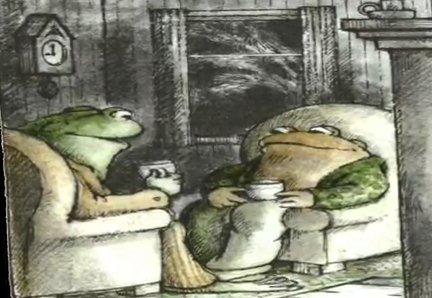

Arnold Lobel is probably my favorite children’s book author, and a master at generating philosophically suggestive narratives. The Frog and Toad books, in particular, are full of stories that raise many puzzles about life and experience.
One of my favorites is the story “Shivers,” in Days With Frog and Toad. Frog tells Toad a ghost story and Toad interrupts several times to ask things like, “Are you making this up?” and “Is this a true story?”At the end of Frog’s story, Frog and Toad are scared and are “having the shivers,” which, Lobel writes, “was a good, warm feeling.”
Can being scared be a “good, warm feeling?” Why do people like scary stories and films? Is it fun to be scared? When we feel scared, say, listening to a story or watching a film, are we really scared? (We don’t call the police or scream for help.) Are we just enjoying the idea of being scared? What is it we experience when we read scary books or watch horror movies?
 Jana Mohr Lone is the director and founder of the University of Washington Center for Philosophy for Children, an academic research center dedicated to research and practice in philosophy for children and philosophy of childhood, and she is an Affiliate Associate Professor of Philosophy at the University of Washington. Jana is the author of Seen and Not Heard (2021) and The Philosophical Child (2012). She co-authored the textbook Philosophy in Education: Questioning and Dialogue in Schools (2016) and co-edited the collection of essays Philosophy and Education: Introducing Philosophy to Young People (2012). Since 1995 she has taught philosophy in classrooms from preschool to college and beyond. A frequent writer and speaker about precollege philosophy, Jana is the founding president of PLATO (Philosophy Learning and Teaching Organization) and the founding editor-in-chief of the journal Questions: Philosophy for Young People. Follow her on Twitter: @JanaMohrLone