
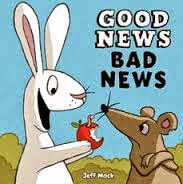
Jeff Mack’s book Good News Bad News portrays the different ways people can see the same situation. Using just four words – good news, bad news – Mack describes Rabbit and Mouse going on a picnic. Good news: they’re going on a picnic. Bad news: it starts to rain. Good news: Rabbit has an umbrella.
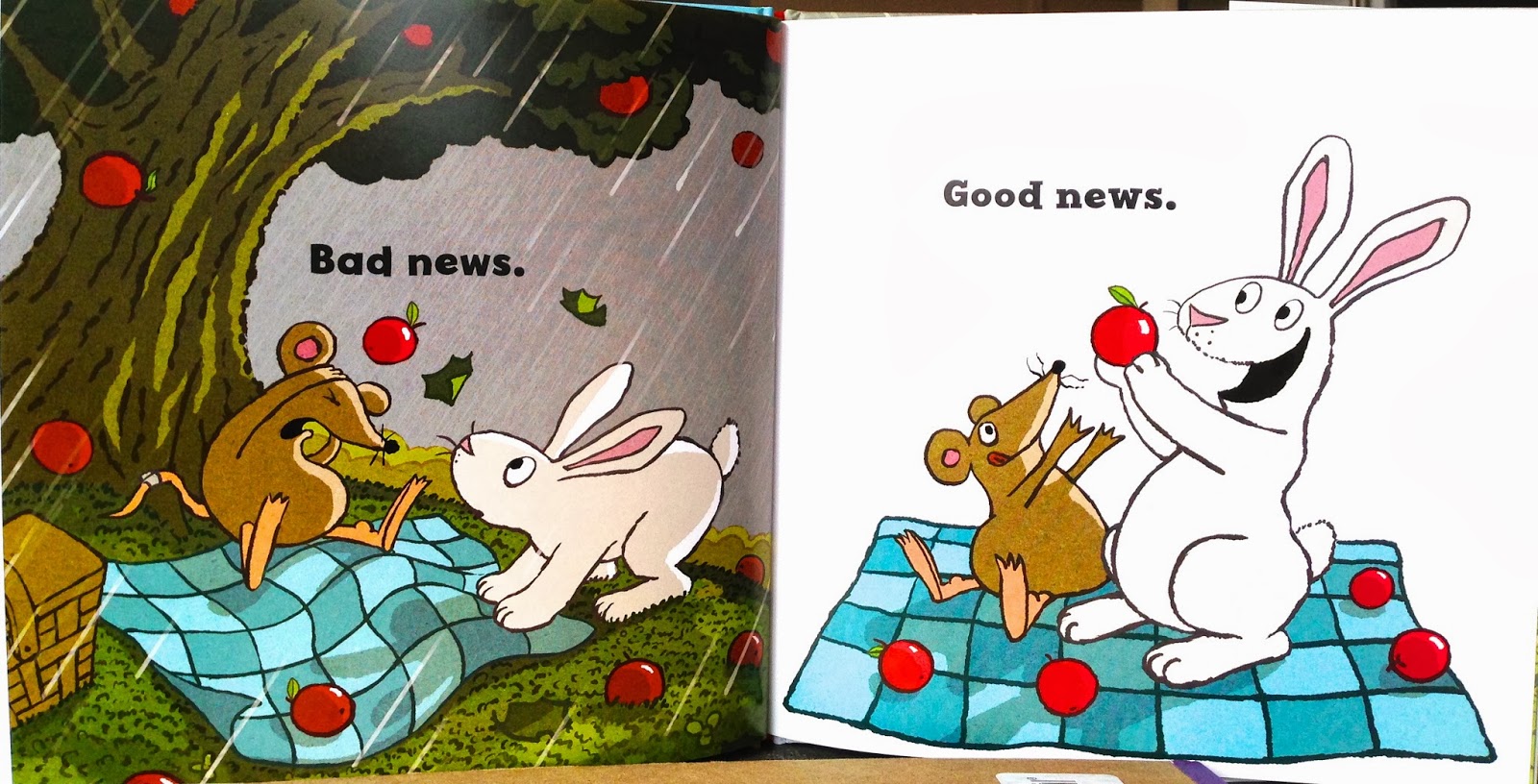
The bad news is, the wind is blowing apples off the tree onto Mouse’s head. But the good news is, there are apples to eat.
Is there more than one way to see something? Does who we are influence how and what we see? Does every situation have both positive and negative aspects? Should we always try to see the other side? How do we know something is “good news” or “bad news?”
My colleague David Shapiro created a game, “Good News, Bad News” that is a great reasoning exercise to play with students in 5th grade and up, and would be fun to play after reading this book aloud: http://depts.washington.edu/nwcenter/downloads/GoodNewsBadNews.pdf
 Jana Mohr Lone is the director and founder of the University of Washington Center for Philosophy for Children, an academic research center dedicated to research and practice in philosophy for children and philosophy of childhood, and she is an Affiliate Associate Professor of Philosophy at the University of Washington. Jana is the author of Seen and Not Heard (2021) and The Philosophical Child (2012). She co-authored the textbook Philosophy in Education: Questioning and Dialogue in Schools (2016) and co-edited the collection of essays Philosophy and Education: Introducing Philosophy to Young People (2012). Since 1995 she has taught philosophy in classrooms from preschool to college and beyond. A frequent writer and speaker about precollege philosophy, Jana is the founding president of PLATO (Philosophy Learning and Teaching Organization) and the founding editor-in-chief of the journal Questions: Philosophy for Young People. Follow her on Twitter: @JanaMohrLone