
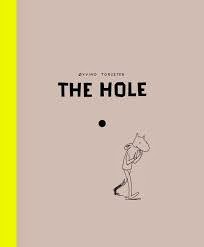
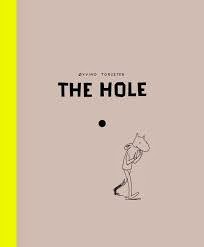
In The Hole by Øyvind Torseter, a man is moving into a new home, and he notices a hole in the apartment. The hole seems to move around, appearing in a wall, on the floor, in a door, etc.
The man makes a phone call, saying, “I’ve found a hole . . . in my apartment . . . it keeps moving . . . take it with me . . . to you?” Attempting to capture the hole in a box, he heads out the door with the box and takes it to a lab for tests.
The book has a die-cut hole that runs through the entire book, and in every page the hole is part of the story.
Are holes part of the world? Are they physical objects? What are they made of? If they’re made of nothing, how do we perceive them? What makes something a hole? Does it have a shape? Do holes really exist? If you fill a hole, is it no longer a hole?
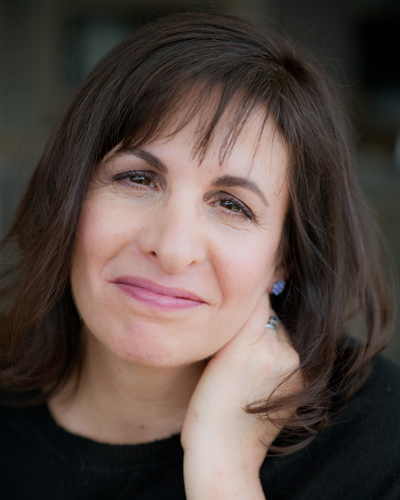 Jana Mohr Lone is the director and founder of the University of Washington Center for Philosophy for Children, an academic research center dedicated to research and practice in philosophy for children and philosophy of childhood, and she is an Affiliate Associate Professor of Philosophy at the University of Washington. Jana is the author of Seen and Not Heard (2021) and The Philosophical Child (2012). She co-authored the textbook Philosophy in Education: Questioning and Dialogue in Schools (2016) and co-edited the collection of essays Philosophy and Education: Introducing Philosophy to Young People (2012). Since 1995 she has taught philosophy in classrooms from preschool to college and beyond. A frequent writer and speaker about precollege philosophy, Jana is the founding president of PLATO (Philosophy Learning and Teaching Organization) and the founding editor-in-chief of the journal Questions: Philosophy for Young People. Follow her on Twitter: @JanaMohrLone