
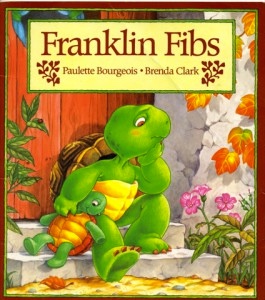
In Franklin Fibs, by Paulette Bourgeois and Brenda Clark, Franklin’s friends are all boasting about the things they can do. Bear can climb to the top of the highest tree. Hawk can soar over the woods without ruffling a feather. Beaver can chop down a tree with just her teeth and use it to make her own dam.
Franklin wonders what to say. He forgets all the things he can do — slide down a riverbank by himself, count forwards and backwards, etc. — and so he fibs, saying that he can eat seventy-six flies in the blink of an eye. Doubtful, his friends egg him on to prove it. Franklin gobbles six flies, and when his friends question him, he claims that he could have eaten seventy more.
Franklin ponders what he should do now. Should he practice until he can eat seventy-six flies in the blink of an eye? Should he desert his friends so they’ll never know he lied to them? Should he come clean?
The next day, Franklin meets up with his friends and admits that he can’t eat seventy-six flies in the blink of an eye. “But,” Franklin says, “I can eat seventy-six flies.” Franklin’s friends sigh. Franklin makes a pie with seventy-six flies and eats the entire fly plate. His friends are impressed. The story ends with Franklin about to brag that he can eat two fly pies in a gulp, but he thinks the better of it.
The story raises interesting questions about the distinction between “fibbing” and lying, and the relationship between telling the truth and friendship, such as:
Why did Franklin tell a fib in the first place?
Is “fibbing” the same as lying? If not, what is the difference?
Is it ever okay to lie?
Is lying for a greater good okay? In what cases would lying be acceptable?
Why did it take Franklin so long to tell the truth?
Does lying sometimes improve our relationships? Does it hurt them? What about fibbing?
Is truth important in friendship?
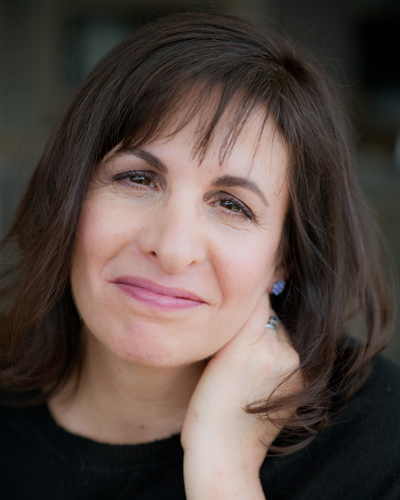 Jana Mohr Lone is the director and founder of the University of Washington Center for Philosophy for Children, an academic research center dedicated to research and practice in philosophy for children and philosophy of childhood, and she is an Affiliate Associate Professor of Philosophy at the University of Washington. Jana is the author of Seen and Not Heard (2021) and The Philosophical Child (2012). She co-authored the textbook Philosophy in Education: Questioning and Dialogue in Schools (2016) and co-edited the collection of essays Philosophy and Education: Introducing Philosophy to Young People (2012). Since 1995 she has taught philosophy in classrooms from preschool to college and beyond. A frequent writer and speaker about precollege philosophy, Jana is the founding president of PLATO (Philosophy Learning and Teaching Organization) and the founding editor-in-chief of the journal Questions: Philosophy for Young People. Follow her on Twitter: @JanaMohrLone